Events
MODERN ECOSYSTEMS: RESEARCH BETWEEN ART AND ECOLOGY IN NORTH MACEDONIA
08/10/ 2022 – 26/10/ 2022
The goal of this innovative project is to stimulate public awareness of the importance of North Macedonia's natural heritage and the artistic value of its biodiversity, especially with the establishment of the new Shar Planina National Park on the borders with Kosovo and Albania, which will increase the total area of protected areas to 14%.
To achieve this, two Italian artists, Roberto Gezzi and Antonio Massaruto, who have always worked “through” and “in” the natural environment, came to North Macedonia to create their works on the ground, interacting with the rich Macedonian fauna and flora. The project thus allowed for an interesting parallel to be drawn between the beautiful nature of the two countries.
The artists' work is divided into two phases: preparatory-creative and exhibition phase.
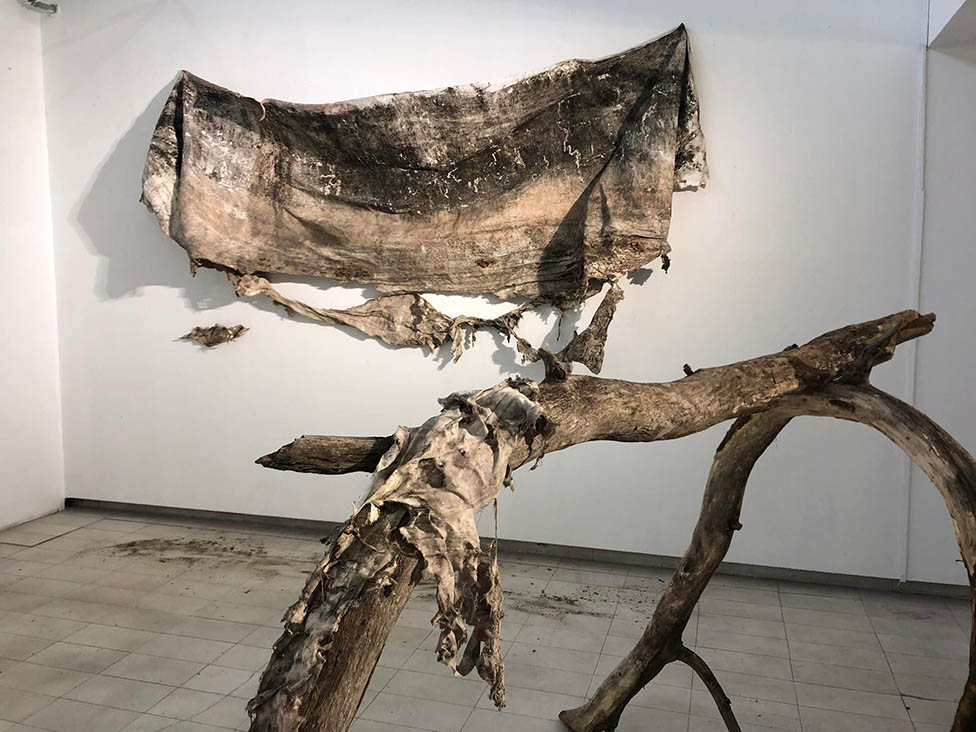
In the first phase (from 18 to 26 April this year – 22 April is the International Earth Day), the artists stayed in the Shar Planina National Park. After identifying the most suitable locations, Roberto Geci embarked on installations aimed at creating “naturographies” at specific locations that interact with ecosystems, while Antonio Massaruto created sculptures and installations inspired by the typical fauna of the local environment, by collecting natural materials already present on the ground.
The creative phase of the project is fully documented and is part of the final exhibition, along with the works themselves. During the preparation of the works, organized tours were also held by fine arts and design students.
The second phase, which takes place in October 2022 (from 8ми up to and including the 26thти), is intended for the exhibition of the works in the premises of the Museum of Contemporary Art in Skopje. A catalogue will follow. The artists' works are displayed with an emphasis on dialogue (conceptual and/or visual) with the collections already present in the museum.
ABOUT THE ARTISTS
The painting and installation work of Roberto Geci which has always been based on his strong interest in the natural landscape (explored through pictorial representation but also through field experimentation) moves from a starting, scientific approach to organic reality to then reach a conceptual form through matter itself.
Naturographies, in essence, are works that arise from studies and experiments on natural, mostly uncontaminated living environments, and whose title contains within itself the basic concept of both the final result and the process of creation. The latter is actually an integral part of the work, in the journey to the origin of the relationship between the artist and nature, where the supporting pillar is the intimate relationship between them.
The artist creates with nature, but, at the same time, supervises each phase of creation: from the determination of the initial variables, to the time factor, to the final form. Roberto Geci's work always begins with the study of the living environments that will become the terrain for the creation of the installations. After researching the environment (from an aesthetic, physical, chemical and biological point of view) and developing a precise graphic project, the artist chooses the material, the most appropriate tissue matrix for the installation on which nature will act over time. This phase is followed by production, installation of the supports and observation until the moment of extraction and conservation, which takes place when the fabrics have completed their interaction with the soil in which they are immersed/buried. This type of modus operandi is open to multiple interpretations, from a philosophical, artistic and scientific point of view.
In fact, it is an unusual production of mixed aesthetic canons (natural-human), symbolic valences (the artist delegating the "reactive" component to nature), ethical aspects, the tendency for understanding and dialogue with the landscape and its protection.
In addition to their indisputable artistic content, naturographies also include other meanings. By their intrinsic nature as a collection of “matrices”, they are useful indicators for defining the health of the aquatic, soil and air ecosystem, so that they can become a preliminary tool to be used, together with classical scientific methodologies, in surveys and laboratory analyses, a tool that can determine the quality of the environment in which we live, always represented by a complex and dynamic system. Naturography can act as an instrument for mapping and monitoring the territory and the biodiversity that characterizes and distinguishes it.
In fact, they are capable of demonstrating the capacity for growth and regeneration of the elements that make up a particular environment: a method of cultivation, but not in the conditions of a controlled medium in a laboratory but in their natural habitat.
The sculptural and installation work of Antonio Masaruto feeds on spontaneous inspirations from the natural heritage in which he works. Indigenous materials, plant matter, organic and inorganic, but also the cultural and emotional imprint of the landscape and of the iconographic traditions connoted in the most classical artistic tradition become the concrete material with which he works and the matrix of aesthetic research, capable of merging the real and the imaginary, the echo of history with the hints of the future. Masaruto connects with the place. Immersing himself completely in it, he tests and absorbs his subject, the essence. Therefore, he works on his expressive potential and, in an instinctive construction that comes from his deep knowledge of animal morphology, he creates chimerical entities that float between mimesis and myth. His creatures, sketched as skeletons and primitive or more detailed forms that shape complete solid bodies, seem to play with time.
Some appear as “fantastic beings”, which, on the one hand, evoke the power of zoomorphic creatures from classical culture or bestiaries from medieval memory, but, on the other hand, in their birth from the landscape – even before the explicit exploration of the intangible memories of the territory takes place, they become potential beings of the post-apocalyptic tomorrow.
With absolute respect for the ecological context, everything is realized with natural materials: ephemeral and transitory. Therefore, time is also what unreasonably decays, erases and destroys the human ability to build beautiful and bold facades.
There is nothing permanent. There is no glory in art, but the glory of nature that gives everything and takes everything back. Of all these works, perhaps only documents and digital memory will remain to feed the human eye, in the game of eternal return, and the astonishing human capacity to grasp momentary presences and powers in natural and virtual forms.