Events
Panic Room
02/10/ 2020 – 05/11/ 2020
Panic Room, Or: Leap Into Thinking
The consequences of climate change, the processes of which are largely influenced by the way in which humans behave, exploit and destroy nature, are rapidly changing living conditions: polluted air, soil, seas, melting ice, fires, floods, destroyed ecosystems, migrations, hunger, pandemics... The exhibition addresses the state of global danger that threatens the world. With this exhibition, artists, in different ways and with different artistic techniques (painting, installation, drawing, video, photographs, posters, artistic research workshop, interactive virtual and participatory project), draw coordinates for locating the problems that the contemporary world we live in is facing, as well as possible creative platforms as places of departure from the usual practices of thinking and acting.
The concept of the exhibition Panic Room, is to offer certain courses of redesigning or even resetting of our attitude towards natural and social surrounding. Actually , it’s all about different approaches of connecting and solidarity between people and their surrounding ( as opposed to the usual way in which living conditions are taken for granted, as something given to us and belonging to us).
At the same time, the exhibition is also a critique of the neoliberal financial, technological, biopolitical, or necropolitical strategy of manipulating and colonizing all spheres of spatial, biological, and symbolic existence, and a critique of the hidden logic of the functioning of the global market: the more disasters (war, political, economic and ecological crises), the more profit,” says curator Nedelkovska.
Panic room does not mean any safe place to hide (as in David Fincher’s movie from which the title is borrowed), but refers to the intimate, inner space as a place of decision for a decisive turn of thought: instead to accept that it is much easier to imagine the end of the world than the end of capitalism, to leap, leap into thinking and to imagine the end of capitalism, calling for “a new country, a new people”( Deleuze&Guattari) Instead of an ecology of fear, an ecology of thought.
If art can still strike us, provoke us, displace us from our codified worldviews, if it can still initiate creative and critical places from which potential lines of resistance and change could develop, then it must direct all of its creative power toward dismantling the established clichés of opinion from which we constantly feed our prejudices and our resentments.
In this regard, the exhibition should perhaps be read more as a kind of experiment, an exercise in thought, an incentive and an attempt to make thought an event, a force with the potential for transformation and change, rather than just as a display of works that can, through the artistic and aesthetic concepts offered, deeply touch us and momentarily awaken in us the awareness of the danger we have brought ourselves and the world into. Because, in order to think, we need not only to become aware, but we also need to make a turn. A turn in thought.
The exhibition will feature 12 artists in different media: Iskra Dimitrova, Nehat Beqiri, Verica Kovachevska, Nada, Prlja, Velimir Zhernovski, Matej Bogdanovski, Hristina Ivanoska, Yane Chalovski, Gjorgje Jovanovikj, Filip Jovanovski, Nikola Uzunovski and the collective OPA (Denis Saraginovski, Slobodanka Stevchevska).
Curated by: Ljiljana Nedelkovska.
The exhibition is supported by the Ministry of Culture of North Macedonia.
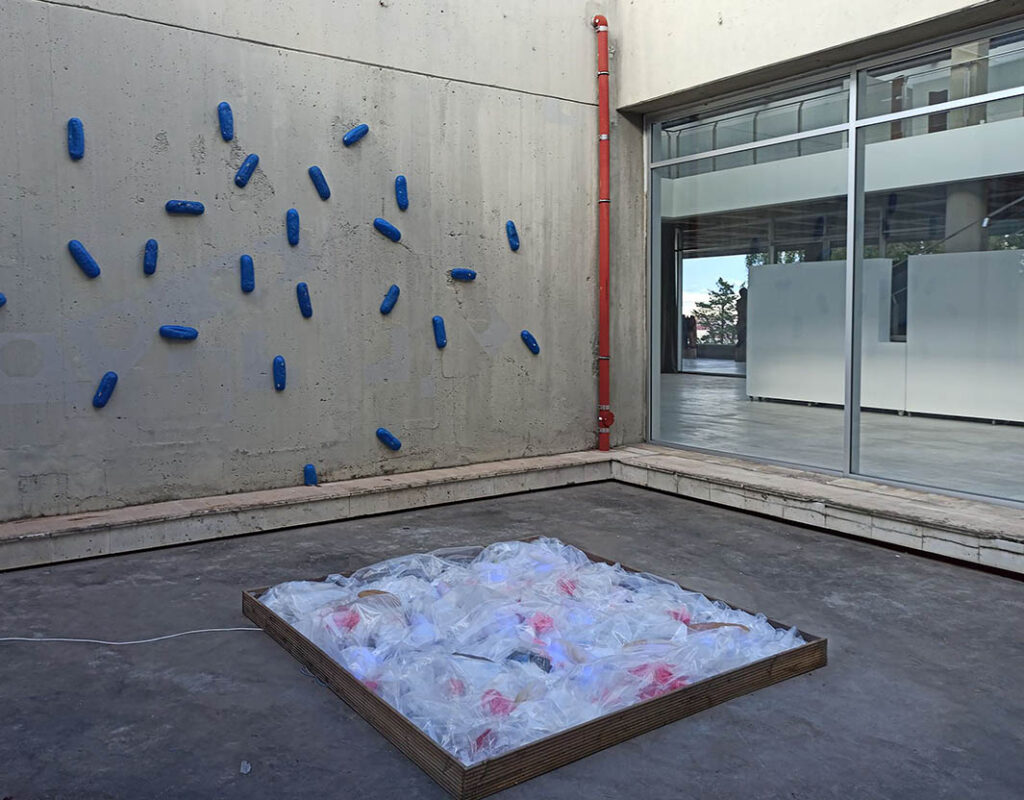
Nehat Beqiri's installation Blue bread addresses the danger of excessive production and consumption of plastic, most of which ends up in the seas. According to data, we have thrown over 150 million tons of plastic into the seas and oceans, while there are about 14 million tons of microplastics on the seabed, data that we should really imagine. The installation, composed of whole loaves of bread (the real ones are painted blue, while the others are made of a transparent material through which weak light radiates) and various plastic waste, associates the floating islands created from plastic, but also the fact that the seas are the source of life on Earth, and that their pollution destroys not only marine life, but also all life on the planet, including humans.
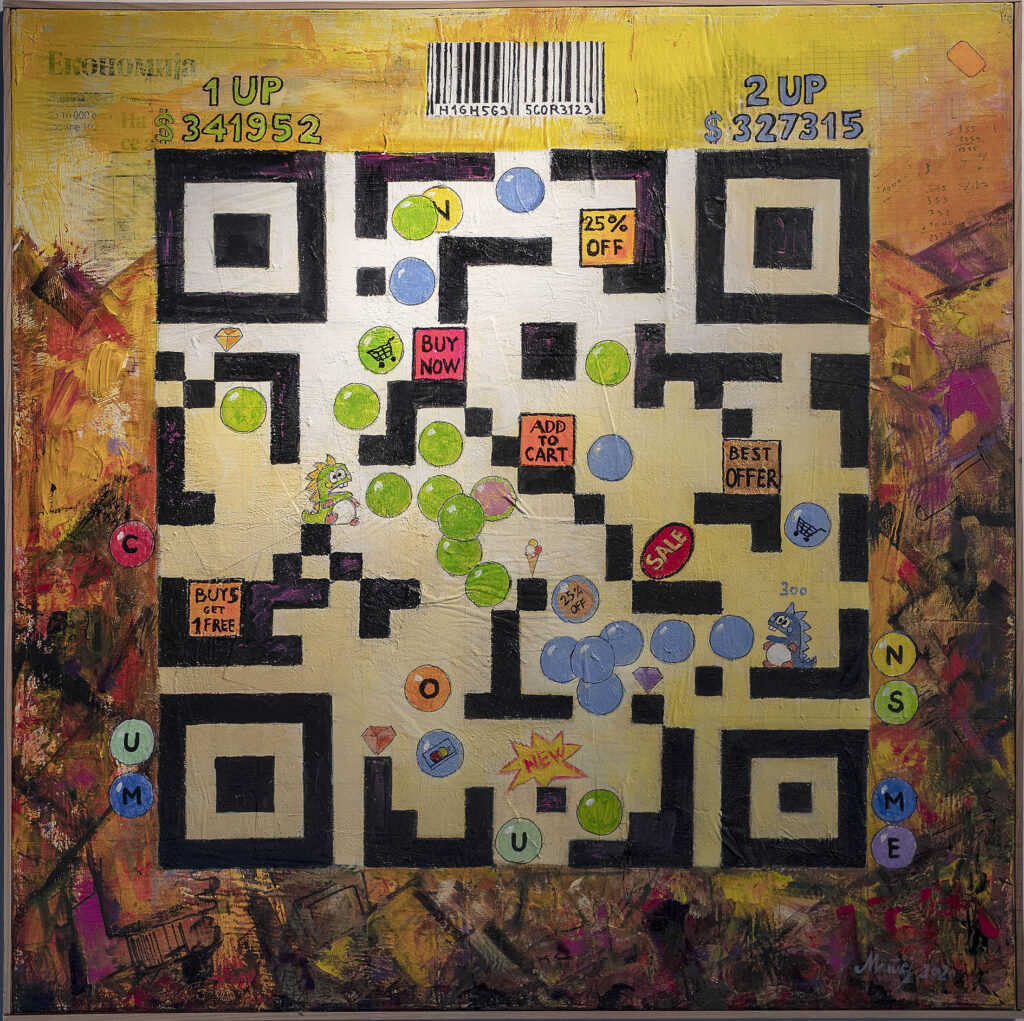
Consumerism is a game played by many, some play it consciously, but many are totally unaware of their involvement. The game is tempting and easy to play, and ultimately it seems like everyone is a winner. There are two types of players, those who buy and those who sell. The aim of the first ones is to buy as much as possible, while the aim of the second is to sell as much as possible, and what makes the game interesting is that both sides need to find a way to achieve the goal. The sellers invent different kinds of adverts, offers and discounts that aim to attract the attention of buyers, while the buyers invent different ways to get money, like taking loans, credit cards, transferring from one account to another, work over hours, all in order to buy the things they long for.
And it seems like there is no end to the game, as in the ecstatic moments of the game the players hardly notice that a definite end will arrive as soon as all the resources are spent: when the whole planet is buried under the remnants of their game and all those shiny and new, bought and sold pleasures end up as waste in the landfills.


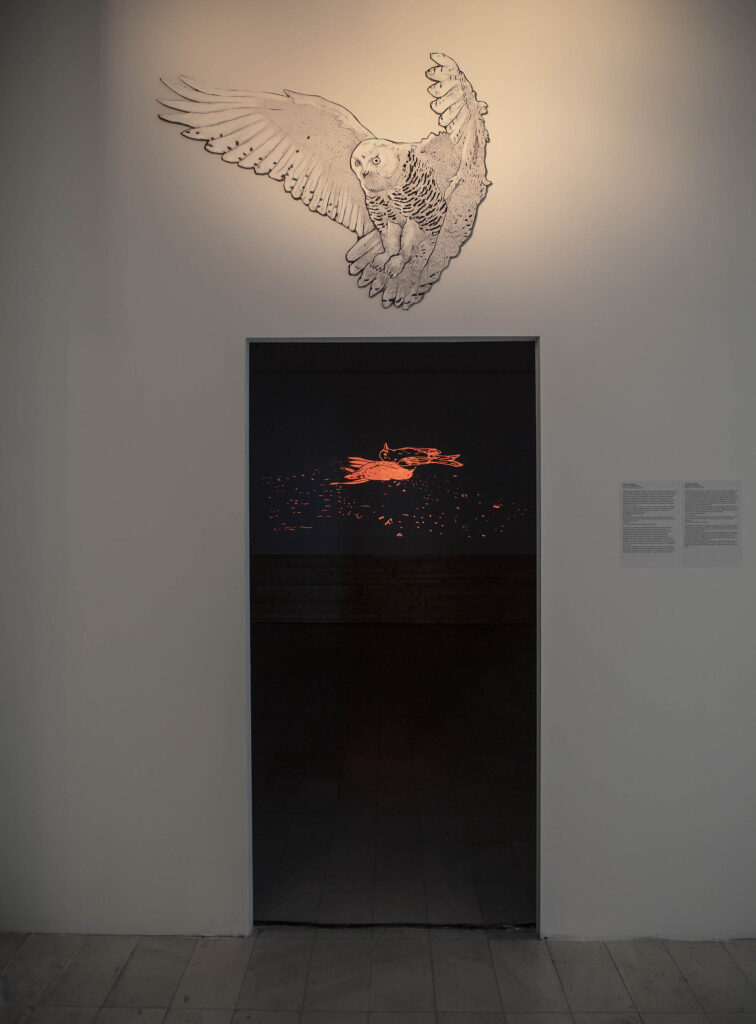
Once upon a time, a long time ago, there lived an old monk in an Orthodox monastery. His name was Pamve. He once planted a dry tree on the slopes of a mountain, just like this. Then he told his young disciple, a monk named Jovan Kolov, that he should take out the tree every day, until it came back to life. Anyway, early every morning, Jovan filled his pitcher with water and set out on a mission, climbing the mountain and in the evening, when it got dark, he returned to the monastery. He did this for three whole years. And one fine day, when he climbed the mountain, he saw the entire tree covered with buds!
Say what you want, but this method, this system has its virtues. You know, I sometimes tell myself, that if every day, at exactly the same time, someone did the same thing, as a ritual, constantly, systematically, every day at the same time, the world would change.
Yes, something would change.
You should.
Someone could wake up, say, every morning at exactly seven o'clock, go to the bathroom, fill a glass with tap water, and pour it into the toilet bowl..
Only that!
From the film Sacrifice by Andrei Tarkovsky
The owl sees in the dark. The symbolic meaning of the owl in many cultures is that it guides you to see beyond the veil of illusion; it helps to see what is kept hidden. It also symbolizes the ability to cut through illusions and see the true meaning of one’s actions or state of mind. In one of its nightly flights, the owl travels and sees the landscapes of the modern world full of environmental disruption and destruction, dystopian images of horror, industrial and technological progress on the one hand, and the increasing alienation of people on the other. Through its images and visions, it confronts us with current and impending disasters. Will we look at these images and once again just state the factual situation or will we try to move forward? To begin with, every morning, let’s say, at exactly seven o’clock, go to the toilet, fill the glass with water from the tap and pour it into the toilet bowl…
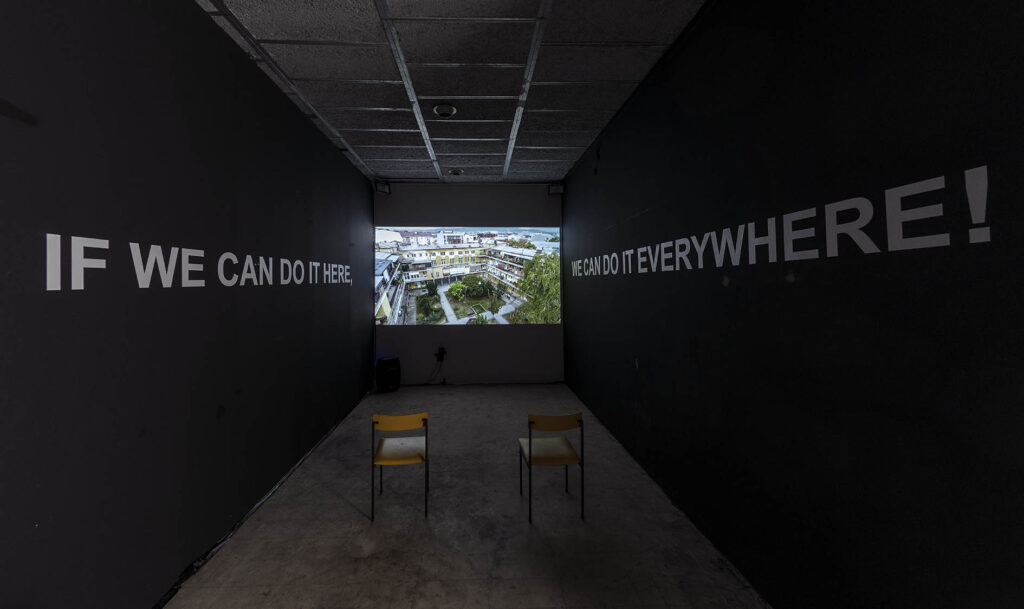
If we can succeed here, we can succeed anywhere!
Erasing, hiding or ignoring the traces of community, solidarity, responsibility, from the collective memory of local history is only a step towards accelerating the neoliberal worldview that privatizes and hierarchizes all relations in social life. All this leads to an almost unrecognizable change in the local context, affecting and transforming entire communities and different social strata, as well as the entire social fabric. In the middle of the common courtyard and the common cinema hall of the residential Railway Building, the questions resound: How can we live better together? And the echo increasingly repeats the question in the almost ruined building that preserves the idea of community, responsibility and solidarity in the middle of the city, dilapidated and corrupt. And it is precisely here that conflicts can open up that potentially create new cracks in the general social structure. The Railway Building in Skopje was built as a perimeter collective block for the living of the employees of the Yugoslav Railways and was completed in the late 1940s. It has its own courtyard, collective laundry rooms that were transformed into apartments after the catastrophic Skopje earthquake in 1963, but also its own cinema as a common space, where at one point 400 children watched films. It is precisely solidarity, togetherness, responsibility that build the skeleton, structure or design of the long-term performative and collaborative project "When Buildings Could Talk" that began in 2015 and is still ongoing.
The initiative "When Buildings Could Talk" is a performative experience that has existed since 2015 in the Railway Building and is initiated by the organization "Faculty of Untaught Things" (FR~U) authored by Filip Jovanovski, curated by Ivana Vaseva. It performs itself and exists through performativity, i.e. it performs an active space or community as an aesthetic and ethical process of creating relationships and connections. Thus, the design of the performance is not a physically built backdrop, although it exists as an architectural space - a cinema hall, but rather an experiential, shaping, emotional and artistic process, formative and transformative, which wants to become a community that will care more broadly than artistic activity or the threshold of one's own home. It is composed of a contemporary cross-disciplinary engaged approach that unites elements of the visual and performing arts, expanding their scope and framework and advocates for the preservation of the meaning of the public and public space.
As part of the exhibition Panic Room Or: Leap in Thought, the project "This Building Speaks (the) Truth" is being performed at a scale of 1:100 as a condensed experience of past activities, as an archive of multiple times that should tell us: If we can succeed here, we can succeed anywhere! And that is precisely the design of the performative agonistic community.
Excerpt from the curatorial text by Ivana Vaseva for the project "This Building Speaks (the) Truth", pavilion of the Republic of North Macedonia at the Prague Quadrennial for Scenic Design and Space 2019
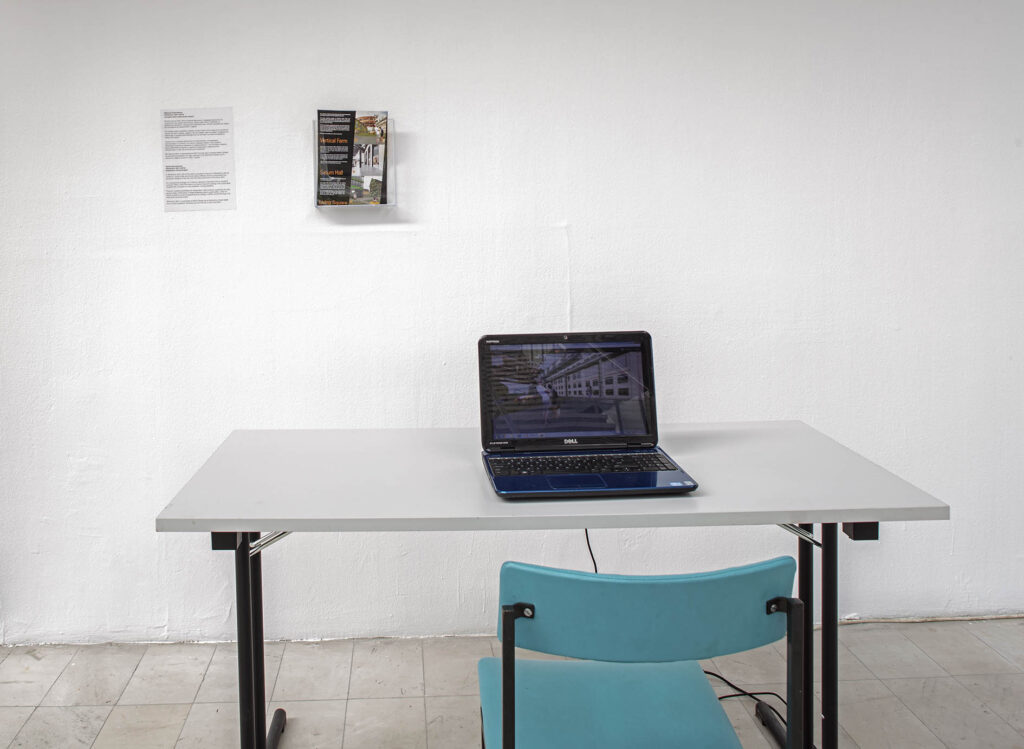
In Winterthur 2041 (2014) the artist organized a city tour of Winterthur with an audience. Using iPads and virtual reality software, the tour showcased four landmark locations in the city and how they would look in the future 2041. An underground passage, for instance, became a blind spot where residents could go offline, while the historic city centre featured buildings with sustainable façades that consisted of living organisms, namely bacteria. The tour created possibilities for imagination, while critically examining the way we live today. Particularly, it raised questions about sustainability – what our future problems would be in relation to food, energy, mobility, and technology, and how could we solve these?
Winterthur 2041 is presented at MSU Skopje as an interactive virtual reality tour in which audience can tour the city in 2014 and 2041.
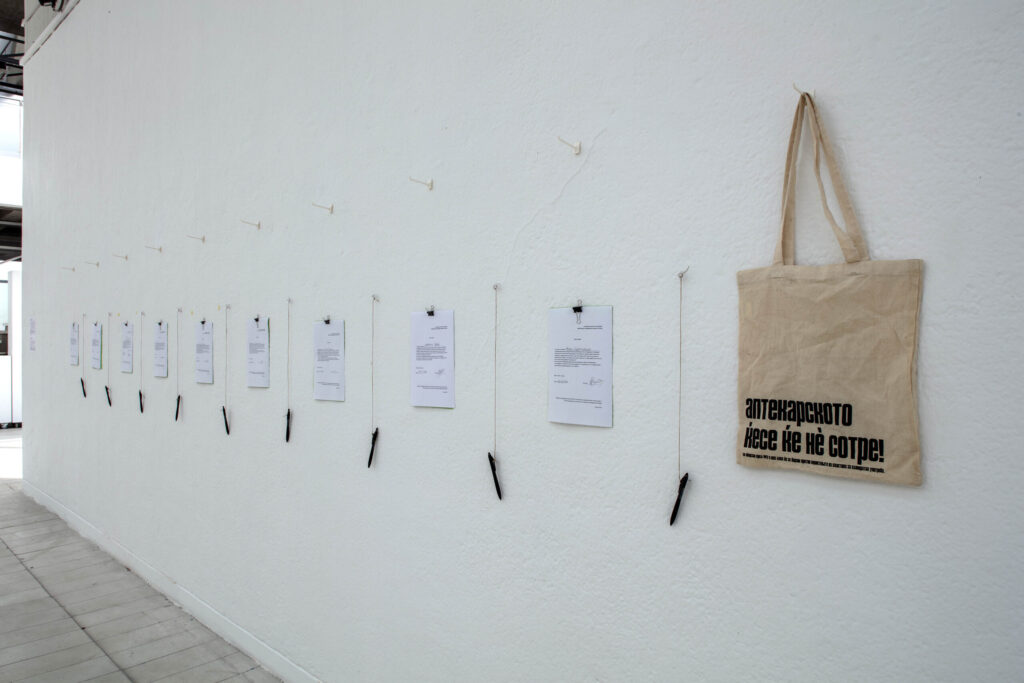
Frightened by the danger caused by a microorganism that fully changed our functioning, we neglected one fact: it is both a consequence and a part of a greater catastrophe. Consumerism,the race for profit, shortsightedness and the destruction of nature in disastrous proportions, work already towards an apocalyptic ending. The level of seriousness requires that each of us strives to actively participate in every segment of our daily life. Otherwise, we will have the “honor” to live the last years of humanity. This project seeks to facilitate such an action. Focusing on one of the causes of the environmental disaster – the production and use of disposable plastics – offers to support us in changing our habits. The rules are simple: take one of the tote bags of your choice, sign the statement below it and follow the instructions. If you are not sure whether you can, or you want to follow the guidelines given by the authors, please leave the bag for someone else. A “tell someone else” action is welcomed and desirable.
Thanks to Alen Redzepagic and Nebojsa Gelevski – Bane (font: Ekran Typeface).