Events
DARKO ALEKSOVSKI: LANDSCAPES OF RAPTURE
08/04/2022 – 26/05/2022
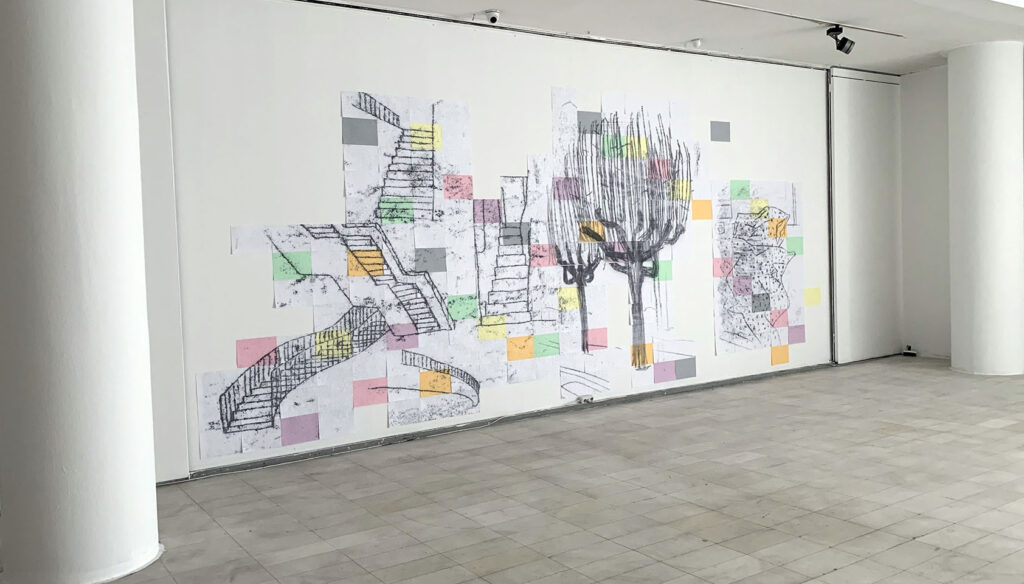
Landscapes of Admiration is a solo exhibition by artist Darko Aleksovski, one of the three award-winning authors for "Most Successful Author and Work" at the 13th International Biennial of Young Artists (2021). The award includes the realization of an independent project at the Museum of Contemporary Art - Skopje.
Statement from the author
Landscapes of admiration[1] is a narrative and exploratory art project consisting of three separate units, which complement each other narratively and formally. The project is a continuation of my current artistic interests named as Places to dream, and starts from feelings of infatuation with specific places and travel as a method of astonishment from everyday life, which he treats as utopian proposals for "overcoming the limitations of an alienating presence [that] allows us to see a different time and place."[2] Landscapes of admiration is a complex portrayal of the search and wandering through everyday life, the emotional processes of falling in love and unrequited love, as well as the constant longing for new, unrealized ways of remembering.
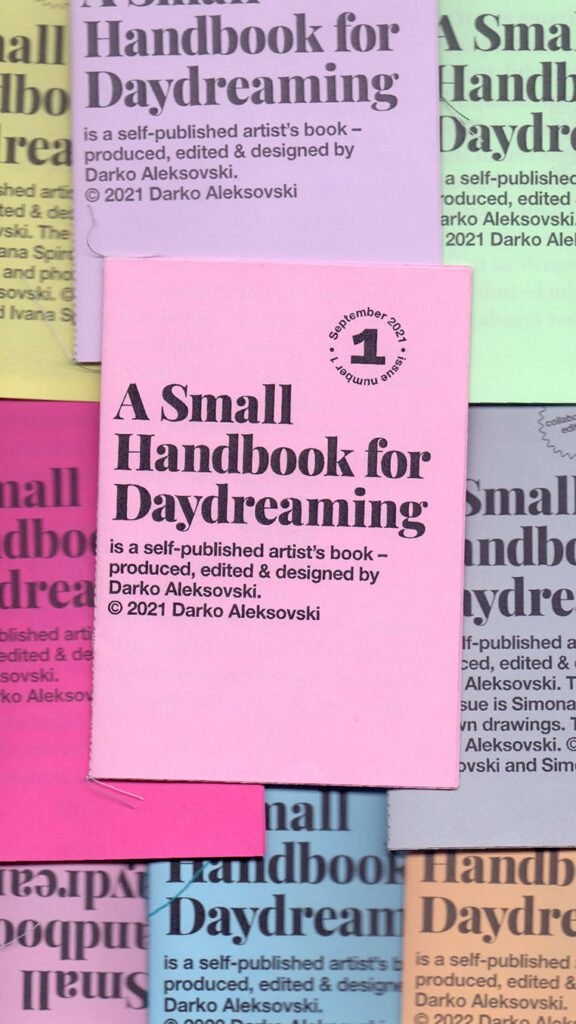
The three segments that make up the entire project are: Мал прирачник за мечтаење(A Small Handbook for Daydreaming) – an ongoing series of self-published art zines; Сцени од секојдневниот живот што постојано се одвиткуваат (Constantly Unfolding Scenes from Everyday Life) – a series of works that deal with the fragmentation and ephemerality of everyday landscapes; and – a series of works that deal with the fragmentation and ephemerality of everyday landscapes; and – a series of collages projected on an analog projector that deal with memories related to the horizon as a place that is utterly unattainable. The works in all three segments are proposals for a multi-layered display of parts of my imagination and their relationship to the reality in which they occur. In that sense, the proposed series of works in different media, as well as the specific contextual placement in the museum space, adapted for their reading, are formed at the intersection between the visual arts and written narration as a narrative tool.
[1] Пејзажи на зачуденоста (eng. landscapes of astonishment) is a term taken from the introduction of Cruising Utopia: The Then and There of Queer Futurity which José Muñoz uses to contextualize Frank O’Hera’s poetry.
[2] Muñoz, José Esteban (2009) Cruising Utopia: The Then and There of Queer Futurity. New York and London: New York University Press.
Selmani is one of the three awarded authors for "Most Successful Author and Work" at last year's 13th International Biennial of Young Artists, and the award includes the realization of an independent project at the Museum of Contemporary Art - Skopje. Before him, the other two awarded authors, Natasha Nedelkova and Darko Aleksovski, exhibited independently this year.
Presenting a diverse and site-specific intervention in the space of MSU-Skopje, the exhibition of textual works, objects, and video attempts to establish new relationships within the given context, clearly demonstrating the ways in which Selmani wittyly uses a specific form of humor to explore and question everyday life, which is usually tied to absurd traditions and hierarchical structures.
Selmani's broad range of works, which focus on various issues of our precarious modernity, ranging from popular culture to the dominant discourses of power that shape our lives, also question historical narratives, stereotypes, and the sense of belonging and exclusion.
Driton Selmani's works are always constructed as an imaginary dialogue, with the audience, but also with himself, as a series of short statements or rhetorical questions, opening new perspectives for our understanding of the self, of the common, and of the various aspects of contemporary life.
The very title of the exhibition clearly shows how Selmani uses unexpectedwith settings and irony – a twist on a Berber proverb, with a reference to a verse from one of his favorite poetic works, "The Stranger" (L’Etranger) by Charles Baudelaire. In fact, he intentionally seeks and finds the points where language breaks, where it opens a gap, a crack between things, words and the newly constructed image, transforming the familiar into a strange unique situation, and then returns again from the fictional to an understanding of the everyday.
Intervening in the realm of language, from ancient folk wisdom to poetry and children’s songs, Selmani’s practice touches on the fears, anxieties and concerns expressed by ordinary people. He aims to deconstruct deep structures and internalized cultural constructs in order to understand them, offering us a unique opportunity to stand together and confront powerful visual works with masterful simplicity. Being in this state of uncanny where the poetic and the political intersect, he is by no means a stranger. On the contrary, it is precisely here that he finds his home.
The curators of the exhibition are: Vladimir Jancevski, Iva Dimovski and Blagoja Varošanec.