Events
Broken Тime. And the World is Made Again by What it Forgets.
28/11/2024 – 23/3/2025
Exhibition of works from the collection of the Museum of Contemporary Art – Skopje and works by contemporary artists
28 ноември 2024 година – 30 март 2025 година
Contemporary artists: Alaa Younis (Kuwait/Jordan), Inas Halabi (Palestine/Netherlands), Siovia Kyambi (Kenya/Germany), Carla Zakagini (Brazil/Sweden) and Ivana Sidzimovska (North Macedonia/Germany)
Graphic design and artistic intervention – Iliana Petrushevska
Exhibition design – Jovan Ivanovski, Ana Ivanovska, architects
Curator team (MSU): Ivana Vaseva, Blagoja Varoshanec, Sofia Grigoriadou, Iva Dimovski, Vladimir Janchevski, Nada Prlja
Concept collaborator – Tihomir Topuzovski
Conservators – Ljupčo Iljovski and Jadranka Milčovska
The exhibition is part of the celebration of the 60th anniversary of the founding of the Museum of Contemporary Art - Skopje.
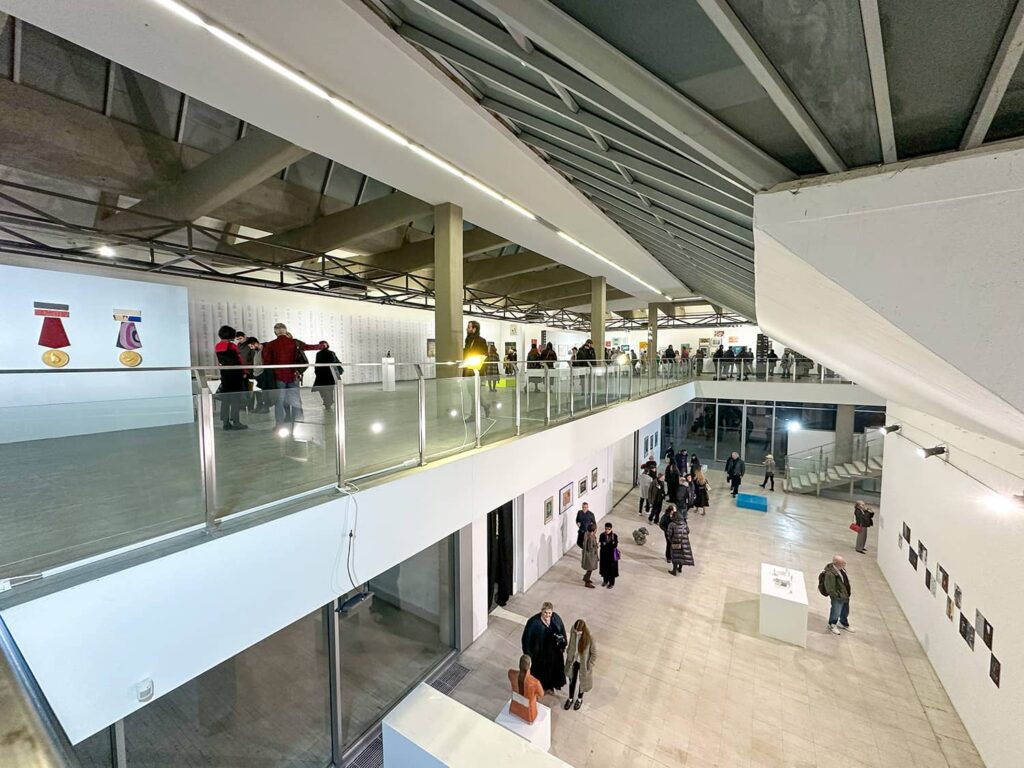
The exhibition "Broken Time. And the World Recreates Itself from What It Forgets" presents a representative selection of works from the collection of the Museum of Contemporary Art - Skopje, some of them rarely or never exhibited, works by artists originating from what was understood as the peripheries of the world or the world understood as a Eurocentric "geopolitics of knowledge", as well as works by contemporary artists, in an attempt to locate different stories, often excluded from dominant narratives, but with great emancipatory power.
Broken Time, responding to the task of heritage, opens up space for artworks, stories, and ghosts that have not been equally exhibited, imagining possible future readings of the MSU – Skopje collection, which are inevitably haunted by the past.
The general idea of the exhibition is to reexamine historical and critical themes such as colonial history and neocolonialism, feminism, hegemonic exploitation, the hybridity of cultural formations and transformations and the corresponding resistances and struggles, as well as the complex realities of countries (and groups) that are conceptualized as “peripheral.” The exhibition is built on works from the MSU collection that originate from the Global South—understood as a heterogeneous and deterritorialized category—or those that do not participate in the global market with a hegemonic position and are archived under a national sign, i.e. that they originate from Argentina, Bangladesh, Bolivia, Brazil, Venezuela, Egypt, Iraq, Iran, South Africa, Kazakhstan, Cuba, Kuwait, Morocco, Mexico, Uzbekistan, Uruguay, Chile, but also from other countries where artists from the aforementioned countries have been active. These works, on the one hand, are placed in relation to works from the countries of the former Yugoslavia (North Macedonia, Kosovo, Serbia, Croatia, Slovenia, Bosnia and Herzegovina, Montenegro) as heirs to the politics and legacy of the Non-Aligned Movement, especially active in the cultural field, and on the other hand, with works by contemporary artists who critically question local and global hegemonies. Some of the artists who are part of this exhibition and are part of the collection of the MSU - Skopje are the world-famous Maria Bonomi, Roberto Mata, Aida Carballo, Felix Beltran, but also Remo Biancedi, Roberto Varcarcel, Samson Flexor, Fayga Ostrover, Anezia Pacheco e Chavez, Gerti Sahue, Peter Clark, Max Arruquipa Chambi, Maria Ausiliadora Silva and others.
The selected works of the invited contemporary artists (Younis, Halabi, Kyambi, Zakagini and Sidzimovska) in this exhibition are not experienced as isolated works, but offer the opportunity for ongoing dialogues between them and with the exhibited works from the collection of the MSU-Skopje. Postcoloniality, political actions and artistic forms of resistance, women's bodies and women's perspectives and production, environmental destruction and colonial extraction, haunted colonial and modern narratives, modernist thought and architecture, forms of solidarity and deconstructions of the national, are some of the themes that the artists deal with, but not exclusively, since more than one of these themes can be followed in each work.
By bringing the works from the collection into relationality with works by contemporary artists, a potential framing is opened for contextual and critical stories about postcolonial solidarity, transformative emancipation and collaboration, and an attempt to establish another representative anti-hegemonic identity of the museum. Undoubtedly, the MSU collection, thus placed, can be used to reexamine existing exhibitions, as well as the knowledge (epistemology) about the collection, which will also be a kind of revocation of the power (politics) that it represented.